Showing posts with label agriculture. Show all posts

Organic manic

Gee, I'm so surprised:

The organic movement touts the sustainability of their methods, but its claims do not withstand scrutiny. For example, a study published earlier this year in the journal Hydrology and Earth System Sciences found that the potential for groundwater contamination can be dramatically reduced if fertilizers are distributed through the irrigation system according to plant demand during the growing season. But organic farming depends on compost, the release of which is not matched with plant demand.
The study found that “intensive organic agriculture relying on solid organic matter, such as composted manure that is implemented in the soil prior to planting as the sole fertilizer, resulted in significant down-leaching of nitrate” into groundwater. Especially with many of the world’s most fertile farming regions in the throes of drought and aquifer depletion–which was the subject of a 60 Minutes segment on November 16–increased nitrate in groundwater is hardly a mark of sustainability.
Moreover, although composting gets good PR as a “green” activity, at large scale it generates a significant amount of greenhouse gases (and is also often a source of pathogenic bacteria applied to crops).

 From "Why Organic Isn't 'Sustainable" on Forbes.

Farm Report

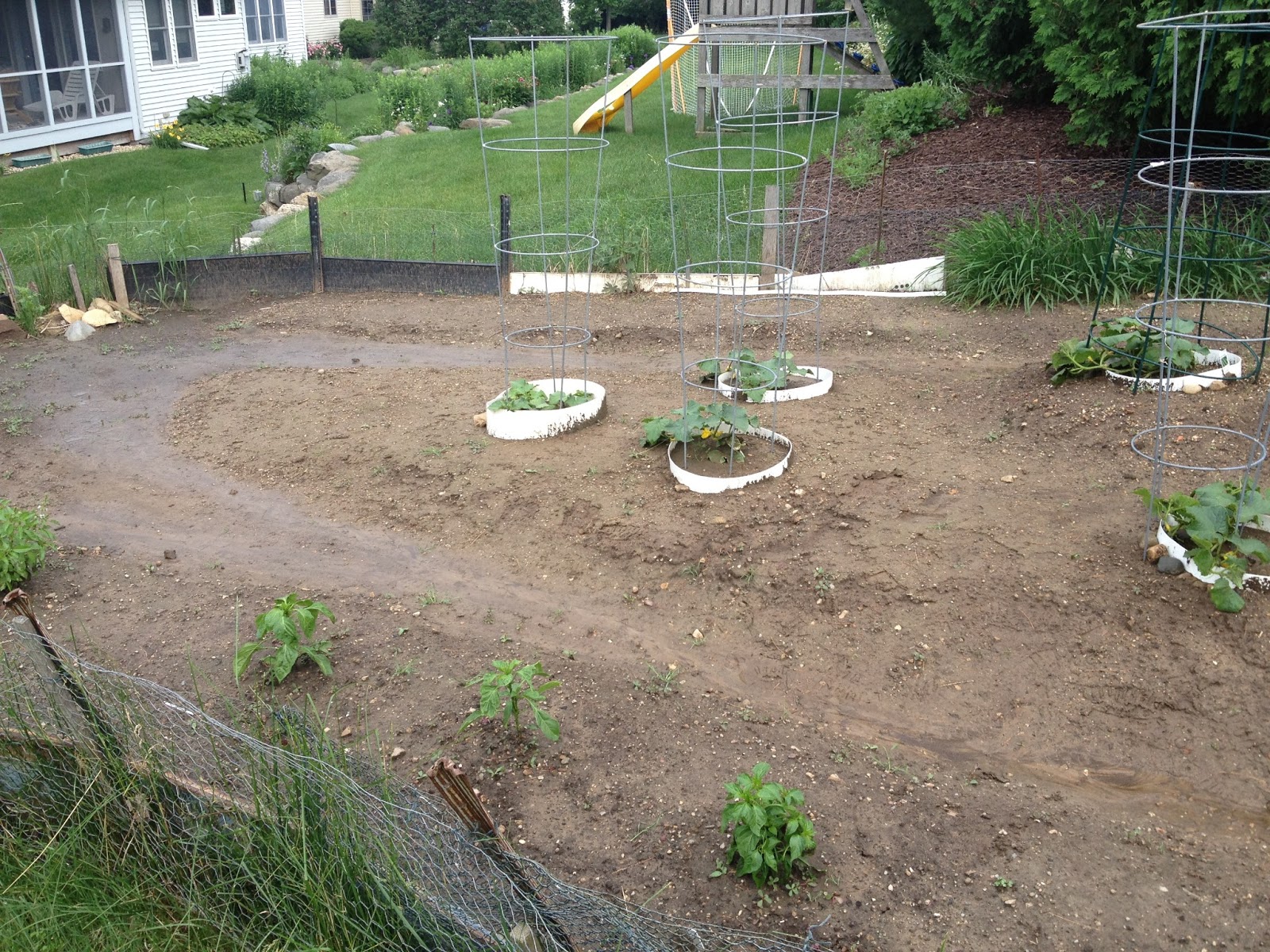
Again, for Mom, a garden report. We had some damage from wind last night and this morning. Several branches of tomatoes fell over. I tied them up better, but am not sure if the ones that fell will survive. There is an ongoing problem with a fungal infection on the tomatoes as well, probably due to the wet weather we have had. This has affected some a lot more than others. Unfortunately, the mosquitoes have come out in force now as well, and it is making garden work most unpleasant. Still, you can see progress since the previous set of pictures.

Garden 2013

For mom. Click to embiggen:

Pay the piper instead

It’s Time To Kick Farmers Off The Federal Dole - Doug Bandow - The Politics of Plunder - Forbes
In a new paper for the American Enterprise Institute, Dr. Barry K. Goodwin at North Carolina State University observed: ”a large share of agricultural subsidies goes to a small segment of society that tends to be wealthier, less financially leveraged, and of higher income than the nonagricultural sectors of the aggregate economy. Moreover, farmers do not generally face more risk than business owners in other sectors, nor do farms fail more often than other forms of business. In fact, farm businesses rarely fail.”

In short, Uncle Sam is playing reverse Robin Hood.
I've long held that first-world agricultural subsidies (which make up the biggest chunk of the EU budget, for example) are not just economically stupid, but immoral. The best way for the poor of the world to make a little money is through farming, but they can't compete with government subsidized and protected farms of the first world. At $60 billion a year, this would be an easy cut from the budget.

Greatest man of the 20th Century has died

The people who we think of as the great men of the 20th Century: FDR, Churchill, etc. don't hold a candle to the man who affected more people for the better than any other in history. This man literally saved the lives of hundreds of millions of people.

Yet his name is almost totally unknown.

Norman Borlaug. RIP.

Who the heck is he?

He was an agricultural scientist who helped engineer hearty, high-yield crops that have fed the Third World. Back when people were predicting mass starvation because of out-of-control population growth, he very quietly solved the problem.

The masses didn't starve because Borlaug fed them.

Some estimates have him saving a billion lives.

He was not unknown to everyone, and back before the Nobel Peace Prize became a joke, they were smart enough to give him one.

Here are a list of the awards he received in his life:

  • Nobel Peace Prize, 1970

  • Election to the U.S. National Academy of Sciences, 1970

  • Aztec Eagle, Government of Mexico, 1970

  • Outstanding Agricultural Achievement Award, World Farm Foundation (USA), 1971

  • Presidential Medal of Freedom (USA), 1977

  • Jefferson Award, American Institute for Public Service, 1980

  • Distinguished Achievement Award in Food and Agricultural Sciences, Council for Agricultural Science and Technology (USA), 1982

  • The Presidential World without Hunger Award: Educator/Scientist category (USA), 1985

  • The Americas Award, The Americas Foundation (USA), 1998

  • Jefferson Lifetime Achievement Award (USA), 1997

  • Altruistic Green Revolution Award, Indian Council of Agricultural Research, 1998

  • Recognition Award for Contributions to World Wheat and Maize Research and Production, Republic of El Salvador, 1999

  • Dedication of Norman E. Borlaug Center for Southern Crop Improvement, Texas A&M University, 1999

  • Vannevar Bush Award, National Science Foundation (USA), 2000

  • Memorial Centennial Medial of the N.I. Vavilov Research Institute of Plant Industry (Russia), 2000

  • Public Welfare Medal, National Academy of Sciences (USA), 2002

  • The Rotary International Award for World Understanding and Peace; Barcelona, Spain, 2002

  • The Philip Hauge Abelson Prize, American Association for the Advancement of Science, 2002

  • Award for Distinguished Achievements to Science and Medicine, American Council of Science and Health, 2003

  • National Medal of Science (USA), 2004

  • Padma Vibhushan in Science and Engineering, awarded by the Government of India, 2006

  • Norman Borlaug Institute for International Agriculture created as part of the Texas A&M University System, 2006

  • Congressional Gold Medal, received 2007

  • Texas A&M University honorary doctor of letters degree, 2007

  • Borlaug received more than 50 honorary degrees in his career.

Dumb turkeys (II)...this time at the NYTimes

Just a few days ago, my brother debunked the always-silly idea that turkeys are so dumb (how dumb are they?!) that they turn their open beaks up to the clouds and drown in a rain storm.

Now, in the New York Times's on their "Idea of the Day" page, subtitled "Must reads from the Week in Review staff" (remember...layers of fact-checkers!) they quote the same article my brother pointed to from the American Enterprise Institute:
Much of his argument comes down to: beware the law of unintended agricultural consequences. Farming without herbicides means more tilling and more erosion. Let turkeys roam outside and they’re prone to attack by weasels, or drowning by their own upturned beaks in downpours. Freeing massive hogs from confinement crates means they sometimes crush their piglets to death, or eat them right after they’re born.
If it's in the New York Times, you know, it must be true!

This is how stupid science propagates.

Steve says: I should point out that I think it's plausible that a severe storm could wipe out a flock of young turkeys. If they get waterlogged, they might die of hypothermia. But drowning from looking up is preposterous.

Dumb Turkeys

From an interesting essay by a farmer (linked from the Corner), "The Omnivore’s Delusion: Against the Agri-intellectuals:"
Weasels were a problem, but not as much a threat as one of our typically violent early summer thunderstorms. It seems that turkeys, at least young ones, are not smart enough to come in out of the rain, and will stand outside in a downpour, with beaks open and eyes skyward, until they drown. One night Niemann lost 4,000 turkeys to drowning, along with his dream, and his farm.

Oh come on! This old wives' tale? Is he serious? I remember hearing this story from a friend of mine in seventh or eight grade. I have always thought it was a rather comical tall tale, told to see who might fall for it.

This guy says it ain't true.

Snopes debunks it too.

Check out google results. Seems pretty clear the story is nonsense.

Now, what to make of the rest of the farmer's blog, if he thinks this is real?